
AI runs on data. Your data.
Adopt AI with confidence.
Protect the data behind it.
While AI has multiplied opportunity for all, it’s done the same for risk. Along with increased productivity and improved decision-making comes the threat of exposed sensitive data through prompts, responses, files, plugins, and AI agents.
Fortra helps security teams establish the guardrails needed to adopt AI safely while giving employees the freedom to use it productively and confidently.
Flag Patterns
Monitor and block questions submitted to AI sites based on sensitive data patterns.
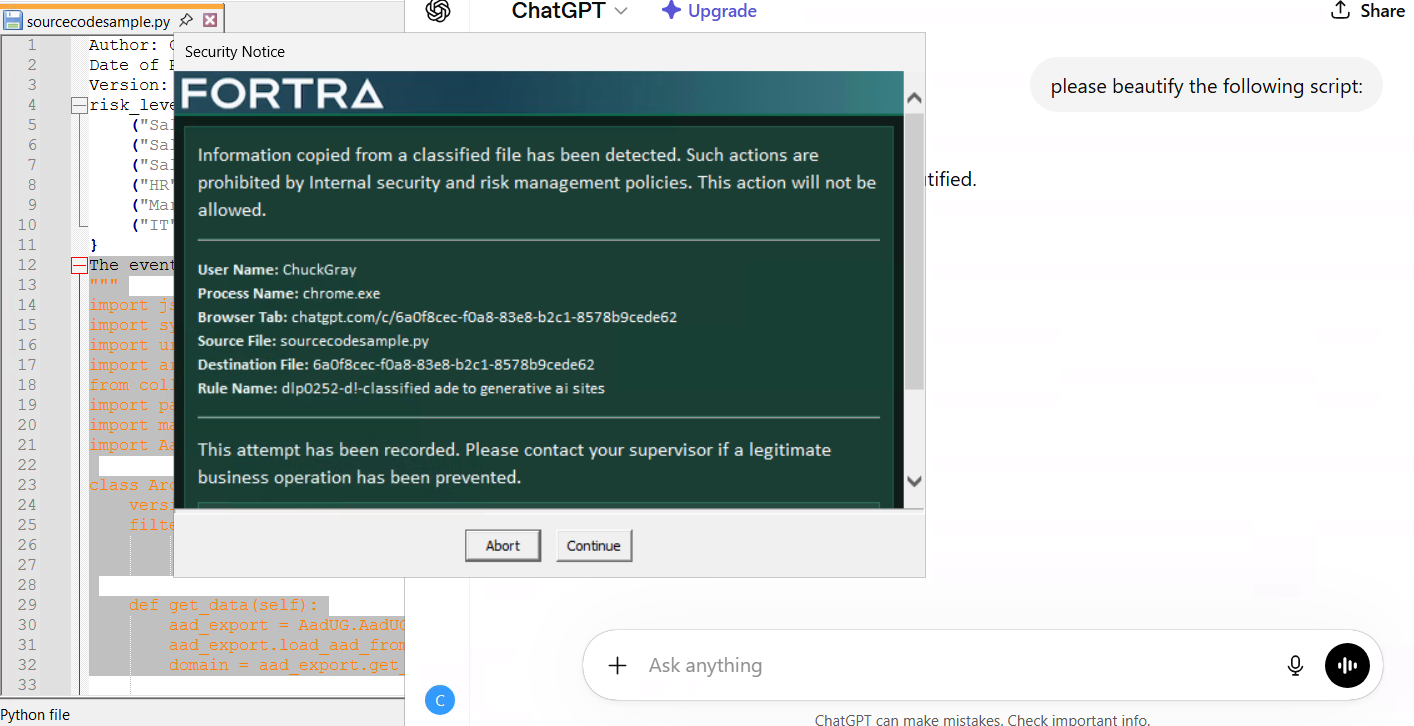
Block Classified Data
Prevent copying and pasting of classified data.
Outright Block
Restrict all traffic to generative AI sites for maximum security.

Protect the data your AI depends on
Fortra provides visibility and control across AI interactions happening across your organization such as prompts, responses, and files. Identify sensitive data, understand how it is being used, and apply protections that help prevent exposure without slowing down innovation.
With Fortra, you can:
Monitor interactions with leading AI tools, including OpenAI, Claude, and Microsoft Copilot
Detect sensitive data in prompts, responses, and uploaded files
Help protect against inadvertent exposure through AI conversations
Monitor both human and agentic interactions through API integrations
Identify sensitive data used by third-party plugins and custom GPTs
Apply guardrails that support responsible AI adoption


It’s not just about files
Sensitive data doesn’t only live in documents and databases. It can also be entered directly into AI prompts or accessed by plugins and custom GPTs. Fortra helps you identify sensitive data wherever it appears across AI interactions so your security team can better understand risk and enforce the right protections.
Enable AI without losing control
AI adoption shouldn’t require your organization to choose between innovation and security. Fortra Data Security for AI helps you create a safer path forward, allowing teams to use AI while maintaining visibility and control over sensitive information.
Schedule a personalized demo to discover how Fortra protects your data to drive growth without letting it become an unintended source of risk.
Fortra Data Security:
20+ Years of Protecting Critical Data


Why "Free" AI Data Loss Prevention Isn’t Enough
So-called "free" solutions with hidden fees may seem cost-effective at first glance, but their limited capabilities often undercut efforts to protect against the complex risks of AI-driven data loss—that is, unless you pay up for extra features.
Read our datasheet to discover how our purpose-built AI DLP platform with predictable, transparent pricing and robust features is the best way to protect your data and budget.
See How Fortra AI Data Security Protects Business
Request a personalized demo to explore our powerful, purpose-built AI data security solutions.
What is the difference between AI data security and cybersecurity?
Cybersecurity protects systems, networks, and data from various threats. AI data security specifically addresses the use, sharing, and exposure of sensitive data within AI systems.
While cybersecurity includes tools such as network protection, endpoint security, and identity management, AI data security adds controls designed for AI-driven environments:
Shielding sensitive data used in AI models and prompts.
Monitoring how data flows into and out of AI tools.
Preventing data leakage via user interactions like copy-paste or file uploads.
AI systems create risks that traditional security may not address. Without additional controls, attackers can exploit how these systems are trained and operated.
Common AI security risks include:
Adversarial attacks: Inputs designed to trick machine learning models into producing harmful or incorrect outputs.
Prompt injection attempts: Manipulated inputs that cause generative AI tools to return unsafe or unintended responses.
Data poisoning: Altered training data that leads to inaccurate predictions or degraded performance.
Standard cybersecurity controls still play an important role, but they do not fully address how data interacts with AI systems. Data security for AI adds additional layers of protection: DSPM identifies and classifies sensitive data and DLP enforces controls to prevent that data from being exposed during training, deployment, and real-time use.