What Is Cold Relic?
Cold Relic is a Russian state-sponsoredcyber-espionage group. Like many other hacking gangs, it has been given a variety of different names by different security researchers - so you may have heard it described before as "Star Blizzard", "Callisto Group", or "SEABORGIUM."
Google previously tracked the group as "COLDRIVER", but renamed it earlier this year as part of an overhaul of how it names different hacking groups - under which Russian groups now have "RELIC" as part of their name.
Ok, so the Threat Researchers Have Lots of Fun Coming Up with Names for These Hacking Gangs - but What Does This Group Actually Do?
In this particular case, Cold Relic targets think tanks, NGOs, journalists and academics, defense contractors, government officials - basically anybody who might have information that could be of interest to the Kremlin.
The hacking group has been targeting people of interest for many years. For instance, the UK's NCSC accused it of targeting British MPs since at least 2015, and in 2023 the US Department of Justice charged two Russian members of the group with launching spear-phishing attacks against targets in the United States and other countries, and stealing information with the intent of manipulating the UK's 2019 election.
So Is There Anything New that the Group Has Been Up To?
Yes, new research published by Google's threat intelligence team describes how the Russian government-backed hackers broke into a US company's Google Workspace admin account. Once there, the hackers stole data, which was then used to impersonate a trusted contact and breach a second US organization via a phishing attack.
Sounds Nasty. Can You Tell Me More?
In late 2025, Cold Relic managed to obtain the login credentials for a Super Admin account for an unnamed organization's Google Workspace environment. The administrator of the account was then bombarded with multi-factor authentication (MFA) push notifications... until they finally approved one, letting the hackers in.
The hackers then exploited their privileged access to the Workspace, registered a new device and generated MFA backup codes for it, and enrolled rogue passkeys. They were then able to export from the admin console lists of the employees, and domain-wide data, deleting security alerts as they progressed to cover their tracks.
Realizing their mistake in allowing the hackers access to the Google Workspace, the victim ensured that passwords and sessions were reset, but overlooked revoking rogue passkeys - which meant that the Cloud Relic hackers were able to continue to access sensitive information for months.
Sheesh. And then they exploited their access to attack another firm?
Correct. An employee at a second company, who had links to the first, was approached via an encrypted messaging app. The message pretended to be from a member of staff from the first company, claiming that their servers had been hit by a distributed denial of service (DDoS) attack.
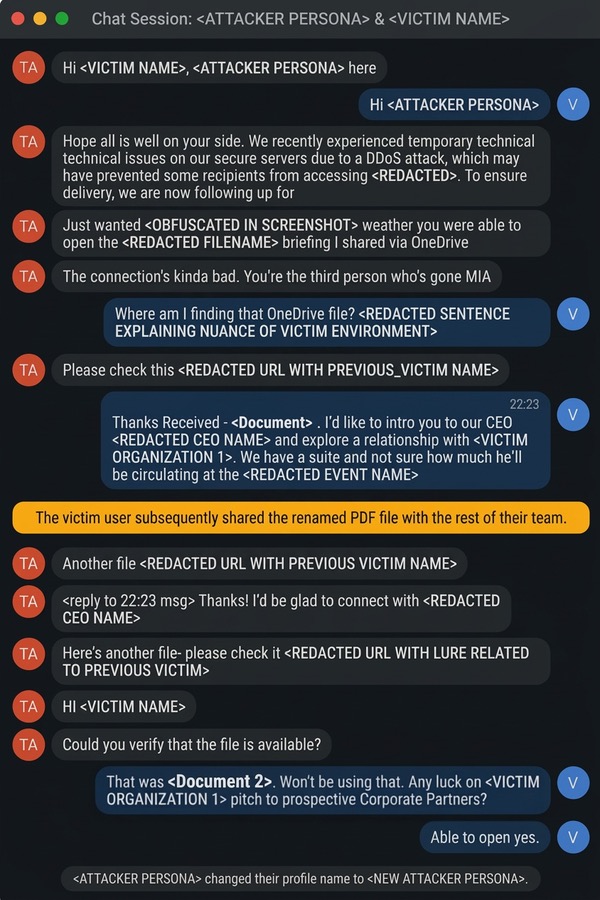
Links shared by the fake worker stole login credentials from the second firm, allowing the hackers to once again enroll their own MFA device and steal data.
Do We Know What Information Cold Relic Is After?
Aside from email and documents, the hackers appear to be particularly interested in gathering staff lists, contacts, CVs, and the like which can help them craft convincing phishing emails to target other potential victims.
So What Can an Organization Do About This?
Google's report on the incident provides a number of recommendations, including:
- Replacing push-based MFA with phishing-resistant authentication, such as hardware security keys.
- Require administrators to approve new MFA devices.
- Flagging or blocking administrator logins from VPNs and residential proxies.
- Preventing staff from storing passwords and other secrets in files stores on cloud drives.