What Is Gunra?
Gunra is a financially-motivated ransomware organization that steals sensitive data from organizations, encrypts it on its victims' computer systems, and threatens to publish it unless a ransom is paid.
Having first appeared in April 2025, Gunra had grown by early 2026 in a fully-fledged ransomware-as-a-service (RaaS) operation, with criminal affiliates carry out attacks using its infrastructure in exchange for a share of the profits.
Earlier this month, multiple agencies including the FBI, CISA, the NSA, and South Korea's National Police Agency issued a joint advisory about the threat posed by Gunra.
Gunra Seems Like a Strange Name. Where Does It Come From?
It's not clear where the name comes from, and unlike some ransomware groups Gunra has not offered an explanation. However, the FBI says that the gang has also adopted a number of aliases (including "Golden Community") in what appears to be rebranding exercise to drive more affiliate sign-ups from the computer underground.
So Where Did the Ransomware Come from in the First Place?
Gunra's code appears to have been derived from the Conti ransomware source code, which in 2022 was leaked online after in-fighting over the group's support for Russia's invasion of Ukraine.
So, a Ransomware Gang Had Its Own Data Leaked?
Yes! You have to love the irony. But unfortunately, Conti's embarrassing leak was to the benefit of other groups such as Black Basta, and now Gunra.
So How Does Gunra Attack an Organization?
Gunra exploits company VPNs and firewalls that are supposed to keep hackers out. In many cases, Gunra's affiliates find companies that have not properly patched against vulnerabilities, and exploit the flaw to let themselves in as if they had a legitimate password.
Once inside, attackers can secretly explore a network, copy sensitive data to their own servers, and then - in a final step - encrypt files, locking staff out of the data they need to do their job, and leave a ransom note named R3ADM3.txt
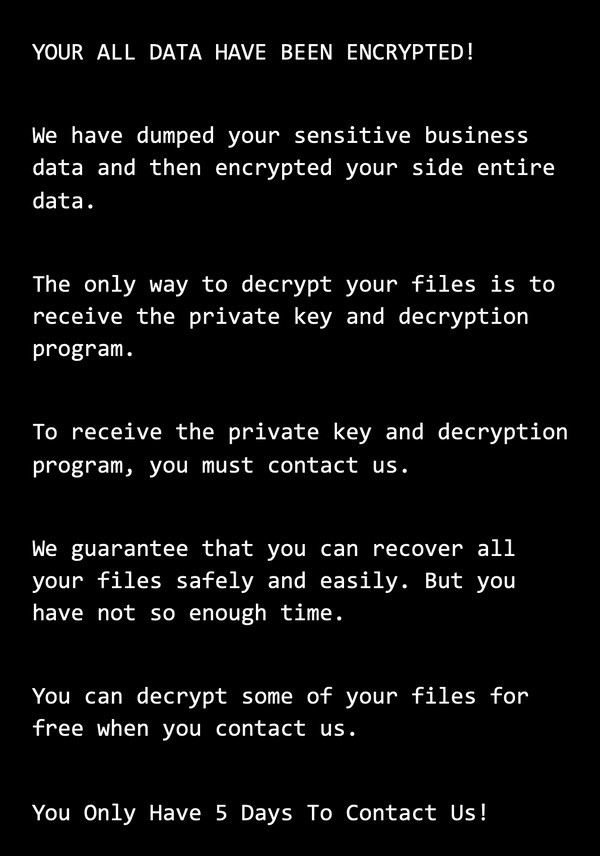
Their Grammar Isn't Great. R3ADM3?
It's "leetspeak" for "README."
Ah. And I'm Guessing that If Businesses Don't Pay the Ransom...
... they won't be given a decryption key, and the stolen data is published on Gunra's leak website or sold to other cybercriminals. Yes, it's the all-too-common story.
According to the FBI, in order to increase pressure upon the organization that has been hit by the ransomware, hackers have been known to email management staff within the company directly, apparently with limited success.
What Sort of Organizations Have Been Hit by Gunra?
According to the joint advisory, victims of Gunra have been spread across multiple sectors including healthcare, financial services, manufacturing, transportation, utilities, retail, and government services, amongst others with victims based around the globe.
Gunra's leak site announced earlier this year that semiconductor firm Trio-Tech had fallen victim, and in a March 2026 SEC filing the company did acknowledge that it had suffered a "material cybersecurity event" which resulted in the leaking of company data.
Is There Any Good News?
Possibly. According to research done by Breakglass Intelligence, victims of Gunra who have been hit on Linux systems may be able to take advantage of the ransomware's generation of weak encryption keys to potentially recover data without paying a ransom.
Unfortunately, no equivalent weakness has been found in the Windows variant of Gunra.
Of course, now details of the weakness has been made public, it's perfectly possible that the Gunra gang has fixed the flaw in their encryption routine on Linux.
So, What Should My Company Do About the Threat?
Organizations who feel they could be at risk from Gunra would be wise to follow Fortra's general advice for defending against ransomware attacks. In addition, reading the latest advisory confirms the importance of not being caught out by the basics:
- Make it a priority to patch known exploited vulnerabilities in internet-facing systems, such as VPN gateways and RDP-exposed infrastructure.
- Enforce multi-factor authentication on all remote access, and monitor for unexpected changes to authentication configurations - not just failed login attempts.
- Segment your network so that one compromised device does not make it easy for an attacker to gain access to everything else.
- Keep offline remote backups, and test that they work properly rather than wait until disaster strikes.
- Disable unused remote access services, and carefully monitor legitimate tools that Gunra and other attacks will often abuse to move around once they have broken into an organization.