Two years ago, a large British firm fell victim to a deepfake scam. The scammers pretended to be company managers and used an artificial intelligence (AI)-generated video call to convince an employee that they were speaking to real colleagues. The employee was tricked into transferring $25 million. A more recent deepfake incident occurred in 2026, when a video circulated on social media sites appearing to show the head of a stock exchange recommending specific stocks and promising investors large profits. The stock exchange later confirmed that video was a deepfake, and it was eventually taken down, only after the damage had already been done.
The idea behind deepfakes is not entirely new. People have been manipulating photographs almost since photography began. You may have seen historical photographs of dictators that have been doctored to remove people that fell out of favor over time. In other cases, removing a horse handler from a photograph of a dictator riding a horse to make him appear heroic.
What has changed is the technology, AI now makes it much easier to create convincing fake images, and even voice and videos. And these fakes are becoming increasingly common. According to a 2025 report, more than half of surveyed companies experienced a deepfake attack in the previous 12 months. And almost half of them reported at least one deepfake audio-call incident or one deepfake video call.
Deepfakes are no longer associated with pranks or celebrity face swaps. They have become a genuine cybersecurity concern. Criminals can use them to spread misinformation, steal identities, and commit fraud.
When you hear the word “deepfake”, you might think of a fake video showing a politician speaking to a group of voters during an election campaign. While this is an example of how deepfakes can be used to spread misinformation, it is far from the only type.
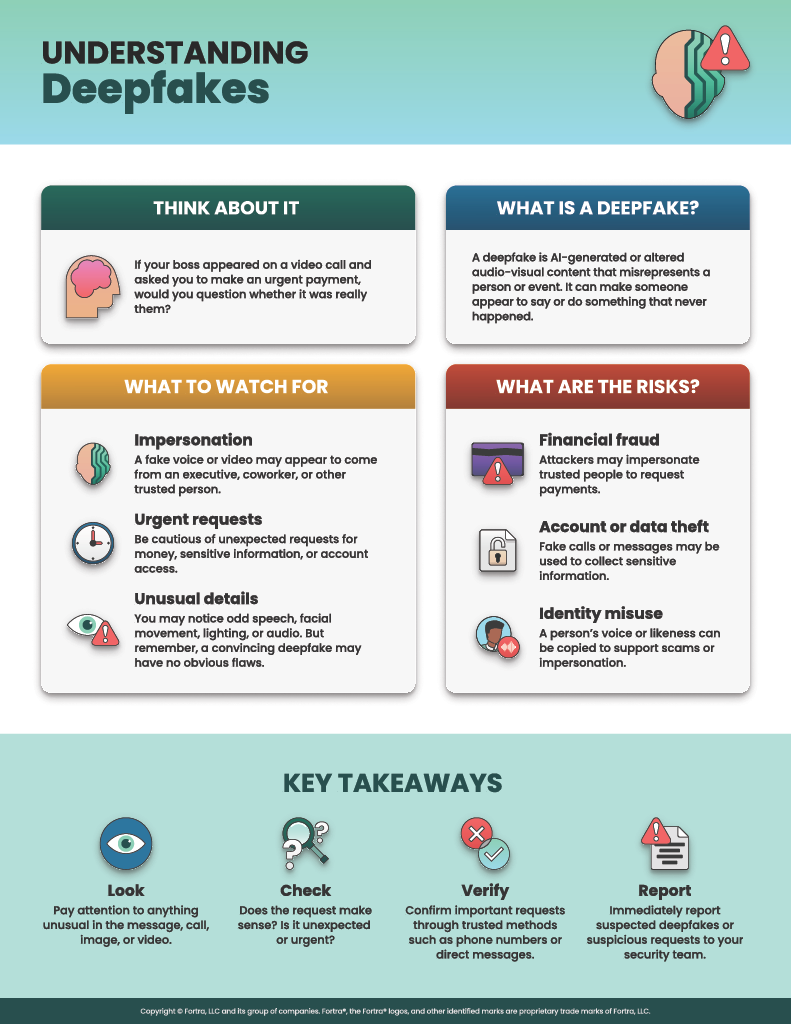
Deepfakes are now used to impersonate company executives, steal identities, commit financial fraud, and trick people into revealing sensitive information in what is referred to as social engineering by experts.
The UK Department for Science, Innovation, and Technology defines a deepfake as a type of artificially created or altered audio-visual content that uses AI to misrepresent someone or something. Deepfakes use AI to make something look or sound real when it isn’t.
Today, deepfakes can take many forms. They include fake or altered images, videos, voices that sound like real people, videos in which a person's lip movement are changed to match words they have never said, in addition to AI-generated avatars. Deepfakes can even be used during video calls, as we saw in the $25 million fraud example earlier.
To understand why deepfakes have become so convincing, it helps to look back at how digital manipulation developed. In the 1990s, software such as Adobe Photoshop made it increasingly possible to alter photographs. However, creating a convincing fake still took time and skill. These tools mainly worked with images, and each image had to be carefully edited by hand, and that made it difficult to create fakes quickly at large scale.
That changed with the arrival of AI. Instead of altering or creating images by hand, AI could learn what a person looked or sounded like and help create convincing fake content much more quickly. This laid the foundation for the deepfakes we see today.
The rise of generative AI changed deepfakes dramatically. Instead of relying fully on humans editing images or recordings by hand, generative AI systems can learn from examples of real images, voices, and videos. These systems can then generate new convincing content.
Early AI systems could learn important characteristics from photos such as facial features, human pose and expressions. This made it possible to do things such as replacing one person's face with another while keeping much of the original image intact.
Other techniques improved the realism of the generated images by teaching the AI system to recognize its own mistakes. One part of the system would create a fake image while another would try to spot if its real or fake. As the system becomes better at spotting fakes, it also becomes better at creating fake ones. This is like a counterfeiter and a detective continually trying to outsmart each other.
These early approaches were impressive, but they were far from perfect. The generated images could sometimes contain obvious mistakes, such as distorted faces, unnaturally looking eyes, or other details that simply don't look right. Videos were even more difficult because everything must remain natural from one frame to the next. Strange blinking, unnatural facial movements, or suddenly changing lighting or shadows could reveal that the generated videos were fake or have been manipulated.
Modern generative AI has overcome many of these earlier limitations. Newer systems learn to create content in different ways, and can generate increasingly realistic images, voices and videos. Some can start with what looks like random visual noise and turns that into a realistic looking image. Others can understand the relationship between text, images, and videos, making it possible to create new content from simple written instruction.
This development has changed the scale of the deepfake problem. Creating a convincing fake once required specialist skills, and considerable time and effort. Today, increasingly capable AI tools make it possible for many more people to create realistic fake content quickly and almost for free.
Why Have Deepfakes Become So Convincing?
Several technological advancements have helped deepfakes improve remarkably quickly. Instead of spending hours in the past or even days to edit images using specialist software, today a growing number of easy-to-use AI tools can create convincing content quickly. The technology can do so much more than simply swap one person’s face with another. Modern AI systems can combine different types of content to create more convincing illusions. For example, an attacker can clone someone’s voice, create or manipulate a video of that person, and synchronize their mouth movements with fake speech. This can make it appear that someone has said things they have never said. The $25 million fraud mentioned earlier demonstrates how this dangerous type of impersonation can be used in a real-world attack.
AI has also become better at creating smooth and consistent video content. Earlier deepfakes were glitchy, but modern AI systems made them better because they are more capable at maintaining a person’s appearance, movements, lighting and surroundings throughout the video, from one frame to the next.
Put simply, AI systems are becoming more capable, the technology needed to develop and run them is becoming cheaper, and the tools are becoming easier for everyone to access. Unfortunately, this can also make them easier for criminals to use.
Can We Spot a Deepfake?
This leads us to in important question: can we tell when something is a deepfake?
Just a few years ago, spotting one could sometimes by surprisingly easy. Fake faces might blink strangely, teeth could look unnatural, or lighting and shadows might not make sense, making it easier to spot them with the naked eye. As AI improved, many of these obvious mistakes have become less common.
Looking carefully can still reveal some clues about the content being fake. You might still notice some of these earlier issues. However, there is important catch: the absence of these mistakes does not mean that something is genuine. Modern deepfakes can be convincing enough that a person may not be able to identify them by simply looking or listening.
Specialist detection tools can look for things that are much harder for humans to notice or identify even if they are looking for them. These might include tiny inconsistencies in facial movements, blinking, reflections, shadows or even subtle change in skin color. Other tools examine whether speech and mouth movements match.
These detection techniques face the same problem, as deepfake technology improves, many of the clues they rely on become harder to find. Therefore, no single visual clue or detection tool should be considered as an absolute proof that something is real or fake.
A good way to identify suspicious content is to investigate where it came from. A reverse image search, for example, can show if an image has appeared elsewhere online and whether and older image has been altered in a misleading context.
Newer technologies can also provide information about the history of digital content. When available, they can provide information about where the content came from and how it has been edited.
These technologies, however, should also be treated as useful evidence rather than a guarantee.
Look, Check, and Verify
For everyday users, the safest approach is to combine multiple checks. Look at the content, consider where it came from, and verify unexpected or important requests through another trusted method. For example, if you receive a video call that appears to be from your boss asking you to urgently transfer money, don’t rely on the fact that the person looks and sounds genuine. Contact them using a communication method you already trust and confirm the request independently.
Today, identifying deepfake content requires a combination of techniques, from looking for unusual visual or audio clues to using digital verification tools. There is no perfect detection method, and as AI improves, deepfakes are becoming increasingly difficult to spot. Ultimately the best defense is good judgment. If something looks, sounds, or feels unusual, particularly when money or sensitive information is involved, stop and verify before you act.
Helpful Resources