Cyber threat intelligence refers to information that helps organizations better understand potential digital threats that could target their systems. By analyzing this data, security teams can identify risks early and take steps to prevent future breaches.
A well-designed threat intelligence system is essential for staying ahead of attackers and responding effectively to security incidents. On the proactive side, it continuously monitors both internal and external environments to detect suspicious activity and uncover patterns in cyberattacks. These insights help organizations decide what security controls or defenses should be strengthened or introduced.
On the reactive side, threat intelligence supports incident response by enabling teams to quickly assess what happened during a breach. It can help identify vulnerabilities that were exploited, guide steps to contain and remediate the damage, and sometimes assist in tracing the source of the attack. For many organizations, cyber threat intelligence plays a critical role in maintaining resilience and minimizing disruption.
4 Types of Cyber Threat Intelligence
Generally speaking, there are four types of cyber intelligence that fit into the overall intelligence lifecycle. Each form of intelligence plays a key role in the information gathering process.
Strategic intelligence
Strategic threat intelligence provides a high-level, 30,000-foot view of the threat landscape, helping decision-makers understand risks and choose appropriate response options. It is typically the most comprehensive form of intelligence and is delivered as reports or structured sets of recommendations that are less technical in nature. This type of intelligence highlights key risk factors, threat actors, attack patterns, and other broad insights derived from defined requirements and analytical questions.
Tactical intelligence
Tactical intelligence focuses on the specific methods and techniques threat actors use to conduct cyberattacks. It helps organizations strengthen defenses around critical assets, improve security in targeted areas, and share timely guidance to keep staff aware of emerging threats.
These reports typically include details on attacker tools, exploited vulnerabilities, and the specific assets being targeted. When delivered in a timely manner, tactical intelligence can help prevent an attack before it reaches its objective. Even when an incident does occur, strong tactical intelligence supports faster detection, quicker remediation, and continuous refinement by incorporating newly observed gaps or missed indicators.
Technical intelligence
Technical intelligence is much like tactical intelligence but relies more on the exact technical execution of the attacks. This type of intelligence often outlines the Indicators of Compromise (IOC), which serve as clues as to exactly what was put at risk, and how a threat gained access.
This detailed information is used by malware researchers and cybersecurity professionals to match the attack to known strings of malware, and to forensically document the breach based on the attack characteristic and digital evidence left behind.
Operational intelligence
Operational intelligence covers detailed, inside knowledge of how a cyber threat conducts its attack. This type of intelligence could contain a list of command-and-control servers, email servers, aliases, and/or potential targets. It often consists of both technical and non-technical details that, when put together, paint a bigger picture of how an organized cybercrime group functions and carries out attacks.
Having solid operational intelligence helps organizations position themselves to directly counter the specific exploits and vulnerabilities that a particular group utilizes to attack its victims. This can range from blacklisting groups of hostnames and IP addresses, to reinforcing particular areas of a network where attackers are known to try to gain access.
Cyber Threat Intelligence Lifecycle
Cyber threat intelligence operates as a continuous closed-loop process made up of six key elements. Each stage feeds into the next, with every step relying on the outputs of the one before it. This structured flow ensures that intelligence is progressively refined and actionable. Any type of intelligence can be processed through this lifecycle.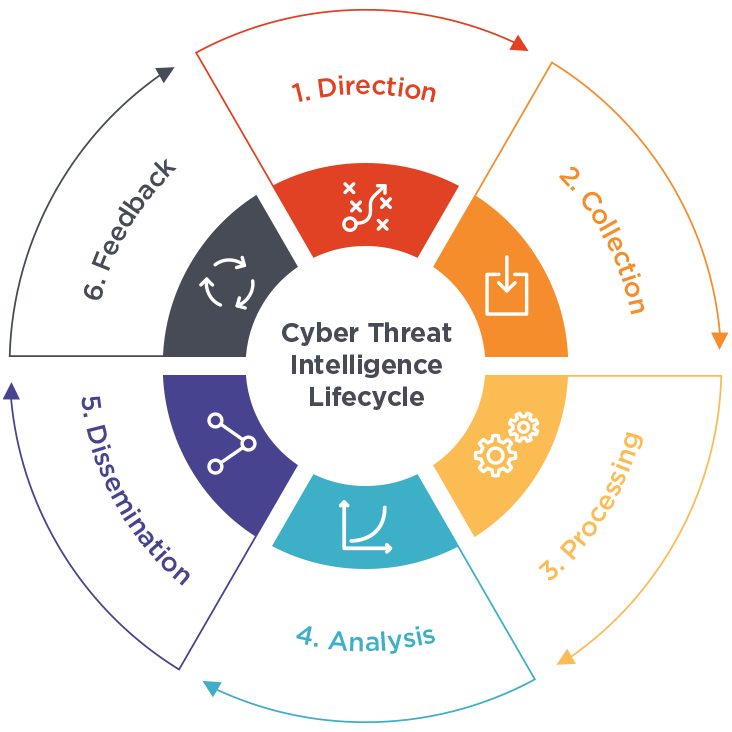
- Direction: The first step is to define what information is needed to make informed decisions in the shortest possible time frame. This helps define objectives that are based off of evidence gathered, such as the nature of the attack, devices involved, and what was compromised.
- Collection: Data collection can consist of digital and physical evidence depending on the incident. This can include audit logs, IP addresses, CCTV footage, or even physical devices, depending on the nature of the attack. At scale, data collection can exceed terabytes of space, meaning proper planning, storage, and processing will need to be taken into account.
- Processing: Raw data is processed into more organized decipherable forms. This can involve literally decoding information, organizing raw data into groups, or tagging information that fits a specific context or source.
- Analysis: A timeline must be established using collected data, and contradictory information must be analyzed further and compared for a clearer understanding of the events as they unfolded. At this stage, patterns and other evidence may emerge, requiring even further analysis. This is often one of the most time-consuming stages of the cycle and is almost always led by a human analyst and aided by other tools.
- Dissemination: The reports generated from the analysis stage must reach key decision makers so action can be taken.
- Feedback: Action is taken based on all the previous steps in the cycle. This could include a retaliation, a new security feature implementation, or could be in the form of adding more data to the cycle for recanalization. Once feedback has been given, the process starts again.
Types of Threats
Not all cyber threats are created equal. Here are a few examples of the most common types of attacks:
- Phishing: Phishing is the act of tricking a user into thinking that a message came from a trusted source when in fact it did not. If the recipient believes the message and enters their login details, those credentials are stolen and then used for financial gain or further espionage into a network. Fortra Threat Intelligence directly combats and prevents email phishing attacks.
- Ransomware: Ransomware has become a widely used tool among both amateur and highly organized cybercrime groups, with increasing sophistication that makes early detection difficult. It is often delivered through email attachments or malicious links, where the payload is disguised and executed quietly in the background. Once activated, it can encrypt files across a system before its presence is fully noticed. Recovery can be costly, with decryption demands often reaching tens of thousands of dollars for individuals and significantly more for large enterprises or organizations, not including additional downtime and operational impact.
- Advanced Persistent Threat: APTs are highly targeted threats that are usually politically or financially motivated. These threats leverage stealth and careful reconnaissance to make their way into a target network to steal, destroy, or spy on an organization. Digital intelligence is key in identifying and repelling these types of attacks. A security operations center (SOC) can help identify a targeted attack and dramatically shorten the time frame needed to remove an advanced threat.
Cyber Threat Intelligence Challenges
Cyber threat intelligence comes with several practical challenges that organizations need to account for. Effective intelligence is not something that can be achieved through basic tools like firewalls or antivirus software alone. Instead, it requires continuous monitoring, real-time threat data, and a coordinated ability to detect and respond to incidents as they happen.
In many cases, maintaining this level of capability is beyond the scope of a typical internal IT team. Organizations often need specialized personnel such as cybersecurity analysts, threat hunters, and incident response professionals to properly interpret data and act on it.
There are also significant technical and financial considerations. Enterprise-grade tools for collecting and analyzing security data can be expensive to deploy and maintain. A common solution is the use of a Security Information and Event Management system, or SIEM, which aggregates logs and security events from across the organization into a centralized system for analysis. While this centralization is critical for identifying patterns and threats, it can be complex to configure and manage, particularly for organizations without strong in-house security expertise.
As a result, many organizations choose to rely on managed services or integrated threat intelligence solutions rather than building and maintaining a full system internally. This approach can help bridge the gap between security needs and available resources while still providing access to actionable threat intelligence.
Stay ahead of Cyber Threats with Intelligence-Driven Protection
Expose external threats early, disrupt threat actors, stop fraud, and reinforce your cybersecurity controls with Fortra Threat Intelligence.