As cyber threats grow more sophisticated, data protection must evolve to keep pace. Advances in artificial intelligence, machine learning, and large language models are introducing new challenges in an already complex world of interconnected devices, distributed workflows, and expanding attack surfaces.
While many organizations already monitor their data, monitoring alone is not enough. A comprehensive solution like Fortra DLP is essential to secure all aspects of digital data, across diverse environments, and in alignment with evolving compliance requirements.
7 Data Protection Challenges Solved by Fortra DLP
1. Solutions that Create Both False Negatives and False Positives
2. Products that Sacrifice Either Security or Productivity
3. Limited Visibility
4. Failing to Keep Pace with New Compliance Regulations
5. Siloed Reporting Complicates Attack Chain Visibility
6. Insufficient Cloud Support Forces On-Premises Deployment
7. Strains Teams and Increases Operational Risk
Where Data Loss Prevention (DLP) Stands Today
We’re living in a world where data is big and getting bigger. IDC estimates that 463 exabytes of data are created every day. While this growth opens incredible opportunities for business, it also creates challenges: sprawling data can overwhelm traditional defense tools. Whether internal or external, accidental or malicious, more data than ever is now at risk of loss or theft. The numbers make the risk clear:
The 2025 Verizon Data Breach Investigation Report recorded over 12,195 confirmed breaches in the past year, and over 22,000 incidents where data was compromised.
With each data breach now costing nearly $4.88 million, it’s safe to assume that the average company would be unable to withstand the blow.
Protecting sensitive data has never been more critical — or more complicated. Legacy DLP tools can’t keep up with cloud adoption, digital transformation, and modern workflows. That’s where Fortra DLP comes in. With 20 years of experience protecting valuable data and intellectual property, Fortra helps organizations tackle the seven biggest data protection challenges businesses face today, including:
- Solutions that create both false negatives and false positives
- Products that sacrifice either security or productivity
- Limited visibility
- Failing to keep pace with new compliance regulations
- Siloed reporting complicates attack chain visibility
- Insufficient cloud support forces on-premises deployment
- Strains teams and increases operational risk
In today’s evolving environment, most status-quo DLP solutions are hard to set up, scale, and maintain. They offer insufficient operating system, browser, and application coverage, and those limitations can be disruptive to end users. Additionally, business leaders often don’t fully understand or support them, further reducing their effectiveness. “DLP lite” alternatives have hit the market, touting “easy to install” agents, but they have no teeth. These lighter offerings offer no controls to stop the loss of sensitive data; after all, data loss detection is very different from data loss prevention. Integrated DLP offerings manage to leverage existing investments, but they, too, leave critical vectors open to sensitive data egress due to an inherently siloed approach.
Comprehensive DLP (which includes Endpoint DLP (eDLP), Network DLP (nDLP), and a host of other cloud-delivered functionalities) is taking over at a time when the industry needs it the most.
Solutions that Create Both False Negatives and False Positives
The problem: Organizations today handle complex data across highly connected environments. Typical data classification (DC) policies are unable to keep up, and many DLP solutions strain under the weight as resources scale and manually crafted policies show their limitations. Insufficient policies create mistakes, and teams are barraged by thousands of alerts generated in error. Security analysts spend significant time chasing false. The cost, complexity, and resources required to follow up on false positives is not sustainable, and too much time is spent continuously tuning DC policies. Fewer false positives would originate if data was easier to find, track, and organize. Additionally, false negatives can occur when data governance tools fail to catch leaked data than has left the network, resulting in an even more critical situation.
The Solution: Fortra DLP’s approach to data protection, leveraging a unique context-based approach, ensures data is reliably and automatically classified, then labeled and marked appropriately. This ensures that at the point of enforcement, accurate decisions are automatically made and minimizes false positives and the need for human interaction.
- Accurate data classification. Fortra DLP combines content, context, and user-based classification for a three-tiered approach, classifying data immediately after installation, eliminating the need for up-front discovery scans.
- Content-based classification. Fortra DLP detects important keywords when the file is in use, then labels them accordingly. This can include numbers that resemble social security numbers, bank account information, medical keywords, and more.
- Context-based classification. Fortra DLP identifies critical file shares, cloud shares, databases, and applications and classifies files when saved from those locations to the local system. These aggregates are based on file metadata such as file type, keywords in the file name, or whether the file originates from a certain website.
- User-based classification. Fortra DLP extends what was previously possible in a data classification solution, allowing Fortra DLP to offer the most unique and comprehensive data classification solution.
Additionally, Fortra DLP can utilize our unique data classification solution (Fortra Data Classification Suite) to augment the accuracy of each DLP detection, as well as improve alert quality across other areas of your ecosystem. DCS offers the deepest metadata support for data labeling for more accurate DLP.
Products that Sacrifice Either Security or Productivity
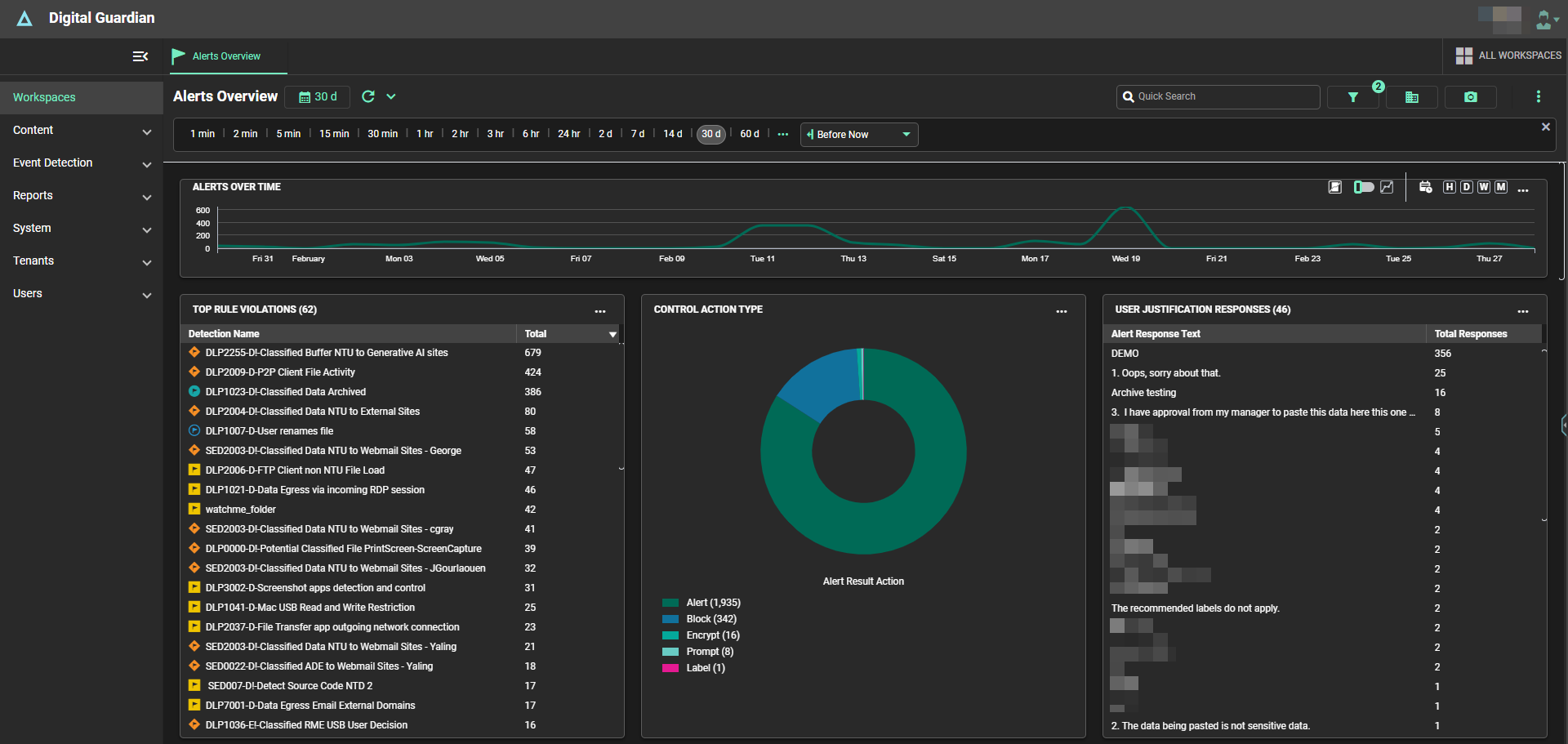
The problem: Your security teams constantly juggle between stringent security protocols and day-to-day effectiveness. All too often, one of the balls drops. While DLP solutions aim to protect sensitive data, they sometimes hinder productivity due to limited processing power and lack of policy flexibility. That makes balancing things like collaboration and large batch transfers difficult to reconcile with gapless security.
The Solution: Fortra DLP enables organizations to define rules and exceptions based on user roles, the level of data sensitivity, and what AI-based tools can learn via machine learning. Granular controls, from “log and monitor” to “block,” automatically protect data before it’s lost, saving your team time and oversight. And if time for creating policies runs short, our “risk discovery” approach lets your team see where data resides and flows, as well as its risks.
Additionally, our support for all operating systems and any browser without installing an extension helps minimize time to value and eliminate potential efficiency-sapping snags along the way. For instance, other DLP providers would be unable to detect data theft over Chrome if the browser was recently upgraded to the latest version, resulting in a Help Desk ticket and a session with a support engineer who would then require the user to install an extension on their machine. With Fortra DLP, teams benefit from flexible deployment options that work wherever they do, saving them time upfront and along the way.
Limited Visibility
The problem: Most DLP solutions build rules around known instances of data loss, producing alerts in a limited “letterbox” view. This leaves the organization vulnerable when an unknown risk pops up, causing customers to capture transmitted data for further analysis. While this may help, it requires dedicated analytic resources, with raised privileges and additional stores of sensitive data that need to be secured and protected.
At this point, increasingly complex and distributed environments continue to challenge traditional DLP policies, making it difficult to capture the full context of each incident. When organizations lack a complete understanding of their assets, it raises a critical question: How can they effectively monitor what’s happening to those assets or build the policies needed to secure them?
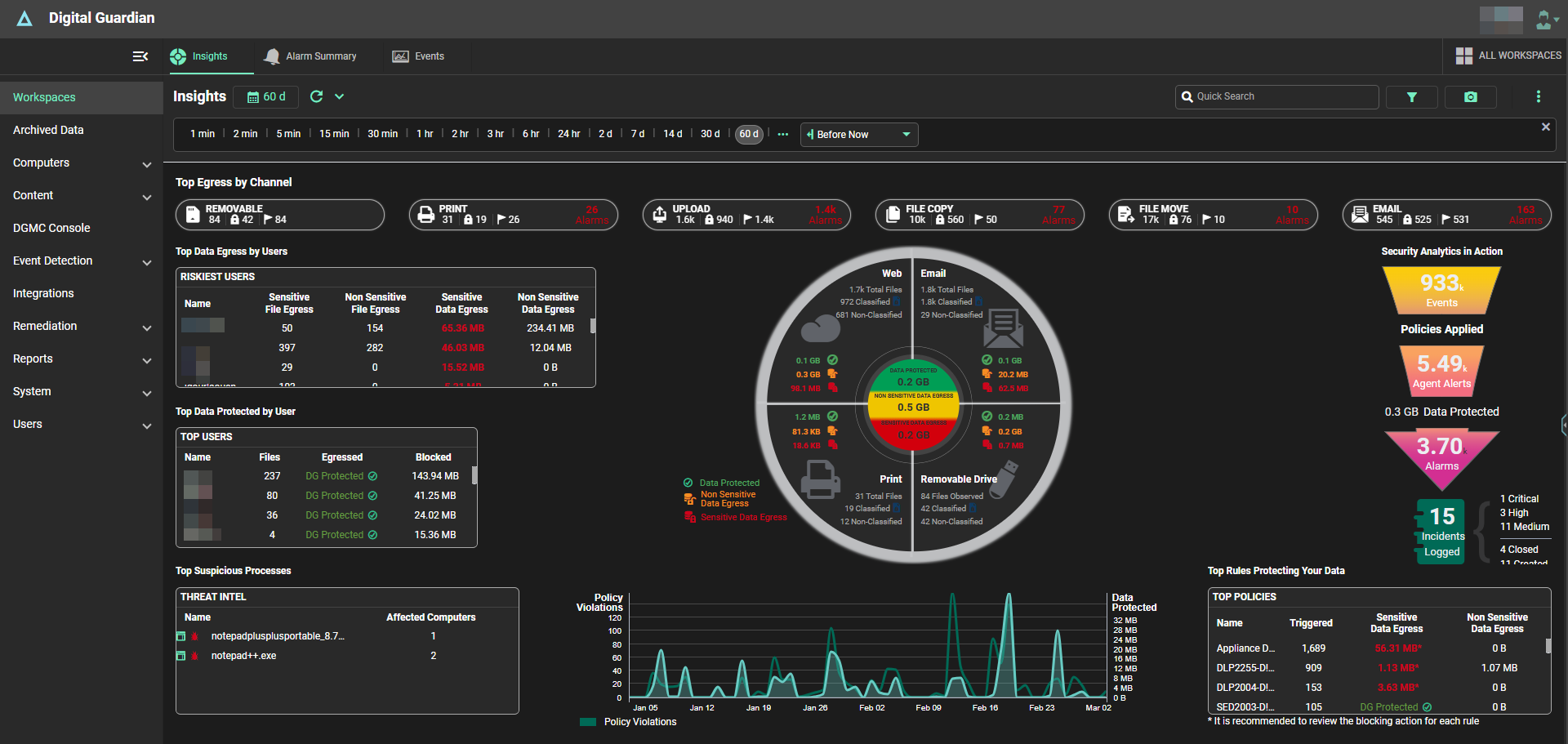
The Solution: Fortra DLP can gather vast amounts of data activity events by default, without policy triggers. This allows all the data activity before and after that “letterbox” view event to be analyzed, giving greater context and understanding without the need to see the sensitive data. To prevent data loss at scale, deep visibility is required that doesn’t compromise the integrity of the data itself.
It does this in two ways:
- Real-time visibility into system, user, and data events such as file save-as, file rename, file/document delete, file copy, cut, paste, system reboot, and content copy.
- Historical detection searches across the enterprise for existing egress and attack activity that may have occurred in the past.
Fortra DLP’s endpoint engine performs this analysis in real-time, stopping risky activity and preprocessing alerts so they are immediately actionable when they hit the management console.
Using our advanced analytics engine, organizations can:
- View high-level snapshots of sensitive data usage across the enterprise
- Drill down to relevant information at the user, machine, or file level
- Target investigations by users or groups using our integrated forensics capabilities
- Integrate Fortra DLP event logs with SIEMs and other event aggregators
Behind our advanced analytics and reporting capabilities is Analytics and Reporting Cloud (ARC), powered by AWS, which leverages streaming data from endpoints and appliances to provide deep visibility into systems, data, and user events to provide the context you need to identify and remediate threats.
Failing to Keep Pace with New Compliance Regulations
The problem: Organizations must keep pace with constantly evolving government, industry, and even internal security requirements in today’s dynamic digital landscape. Achieving compliance requires continuously identifying and accounting for all data tied to specific regulatory obligations. However, complex internal environments and highly distributed ecosystems make it increasingly difficult to locate — and therefore adequately protect — all relevant information.
The Solution: Compliant data is visible data. When data is properly classified, identifying compliance-sensitive content becomes faster, easier, and more automated. With Fortra DLP, you can gain immediate visibility into your organization’s sensitive information — understanding exactly where PII, PCI DSS, IP, and PHI data reside, and how it’s being used. Additionally, built-in device control and encryption capabilities help you maintain control over your compliance-sensitive data.
Use Fortra DLP to help you comply with regulations in between with and such as GDPR, HIPAA, PCI DSS, ITAR, DPDP Act and many more.
Monitor PII, PHI, IP, PCI DSS, and PHI data autonomously:
- Our agents immediately start classifying and tagging compliance-relevant data via automatic content inspection.
- Tags remain with the data no matter its movement, giving you persistent visibility.
- Provide real-time visibility of data transmission:
- Get near real-time reports on the movement of data based on its classification.
- Set alerts for policy violations.
Enforce device encryption policies:
- Requires information written to removable devices to be encrypted using FIPS 140-2 level 2 validated encryption.
- Control who can access devices or media, inside or outside of your organization.
Stop data theft by enforcing device use policies:
- Block, encrypt, or prompt when user tries to copy data to a USB device.
- Identify all removable devices connected to your endpoints by type, manufacturer, model number, and MAC address.
- Control removable devices via endpoint ports like USB, FireWire, eSATA, and webcams.
A global aerospace company called on Fortra DLP to help them meet ITAR requirements that required it to secure several unguarded attack vectors on an aggressive deadline. With current security resources tied up in day-to-day operations, the firm chose Fortra DLP’s Managed Security Program (MSP). With our experts managing both internal and external threats, ITAR-specific data classifications were put in place and sensitive data guarded within the timeframe, all without adjusting the capital budget or adding any additional servers, software, or personnel.
Siloed Reporting Complicates Attack Chain Visibility
The problem: Typical DLP reporting can be siloed, separating factors that work in concert during an attack. Multiple reports need to be combined to give cybersecurity decision-makers the full picture, slowing down investigation, complicating compliance, and hindering remediation.
The Solution: Fortra DLP combines system, user, and data events in a single report. This enables you to spot risky behavior in context and stop it at the moment of abuse. This enterprise-wide intelligence provides a full timeline of events and a defensible chain of custody in the logs which document file movement.
Events generated by the classification software and stored in the reporting database include:
- Sending an email with (or without) a selected label value
- Saving a document with (or without) a selected label value
- Sending an email that contains a policy violation after reviewing the warning
- Downgrading or upgrading a classification level, or attempting to
- Using a classification application on identified computers
Event forensics are recorded by time, user, system, application, file type, file classification, and network operation. Correlated events are bundled, hashed, time-stamped, and cryptographically signed for investigative analysis. Finally, deep visibility reporting presents a full picture of all compliance-related assets.
Insufficient Cloud Support Forces On-Premises Deployment
The problem: Most organizations manage an array of disparate tools and applications to protect their business. Many require them to stand up server infrastructure, deploy applications, and then maintain and update them. This approach incurs significant infrastructure and management costs, requires additional resources as platforms scale, and demands ongoing OS and application maintenance. It also introduces less visible costs, as internal teams are diverted to support and sustain these systems. The operational overhead of deploying new technology is driving many organizations to consider cloud-based solutions as an alternative.
The Solution: Fortra DLP provides a vendor-run SaaS solution, MSP, and on-prem options. Our deployment flexibility sets us apart, and we are one of the few organizations that fully support all operating systems.
Our team is responsible for backups, patching, uptime, scalability and day-to-day maintenance of the DLP solution. Additionally, we takes the utmost care with our customers’ sensitive data, and at no point stores the actual data itself. This ensures only the clients can access to the raw data, as designated by them.
One of our customers — a global leader in workforce management — faced the challenge of protecting thousands of endpoints across a mix of operating systems, browsers, and applications, all while managing a constantly evolving pool of data with a lean IT team. They turned to Fortra DLP’s SaaS deployment to gain granular, scalable data protection without adding complexity. With a simple purchase and rapid rollout, the company achieved instant visibility into all data movement — from endpoint to cloud — without taxing internal resources. Deployed across thousands of machines, Fortra DLP was the only solution that could deliver full coverage for their diverse environment, ensuring both security and scalability.
Strains Teams and Increases Operational Risk
The problem: Aside from operations-level maintenance, many organizations struggle to find or maintain the dedicated resources required to analyze all security instances at scale. Dedicated experts with specific expertise are required to make sense of all the data generated by DLP engines and turn alerts into language the business can then act upon. As cybersecurity skills continue to be in high demand, organizations are challenged to staff their security needs.
The Solution: Fortra DLP’s Managed Security Programs (MSP) remove the resourcing pain point by supplying skilled expertise where it is needed most. We align with the business processes of our customers, minimizing the impact of adoption and ensuring rapid return on investment.
With Fortra DLP MSP, you get:
- Fully managed data protection infrastructure: Get your data protection infrastructure deployed, hosted, and managed by Dortra DLP.
- Visibility, reporting, and threat alerts: Get notified of real-time threats with live and configurable dashboard views that provide to-the-minute insights on critical data usage and threats.
- Immediate access to our experts: Get instant access to Fortra DLP experts with experience implementing mission-critical data security, incident response, risk, and compliance programs for the government and Global 2000 companies.
- Time to value: Get up and running with a phase-one deployment in 90 days or less.
- Cost savings: Use the money you save on upfront technology and staff investment elsewhere.
Fortra DLP offers three MSP options:
Delivering Complete Data Protection Wherever Data Lives
Fortra DLP can protect critical data wherever it lives. Our three core pillars form the foundation of our industry-leading data protection architecture.
You can look forward to fast deployment and results. Our out-of-the-box dashboards enable our customers to see results quickly, coupled with an integrated rapid startup. Plus, our SaaS offering, powered by AWS, presents an option that simplifies and speeds up security while reducing overhead costs and burden to you.
You’ll get cross-platform coverage for your hybrid environment, including your endpoints, corporate network, and any cloud applications running on Microsoft Windows, Apple macOS, and Linux. To get less than complete visibility of data usage across the three primary operating systems would leave gaps in your data protection program.
Finally, safeguard your most critical information with controls tailored to data sensitivity. Fortra DLP enforces both soft and hard usage limits, helping educate users while giving your teams the power to monitor, block, and prevent risky actions in real time. With pre-built policies and coverage across endpoints, networks, and the cloud, you can stay compliant and protect your data wherever it travels.
Fortra DLP is regularly named a Forward Mover and Top Player in Market Quadrant for Enterprise DLP reports. Currently, Fortra DLP secures sensitive data across 5.5 million agents and is trusted by more than 600 diversified blue-chip customers worldwide. Learn more about our industry-leading data protection platform and MSP solutions, then speak with one of our experts for an in-depth demo.